

Beyond the Tape Measure: What Prenatal Care with a Midwife Truly Looks Like
Beyond the Tape Measure: What Prenatal Care with a Midwife Truly Looks Like
You've heard that midwifery care is "different," but what does that actually mean when you're sitting in an exam room, or more likely, on a comfortable couch, discussing your pregnancy? If you're used to the standard OB-GYN model of care, the midwifery approach might feel wonderfully unfamiliar. It's not that midwives skip the important clinical assessments; it's that they wrap those essentials in something deeper: relationship, education, and true partnership.
Let's pull back the curtain and walk through what prenatal care with a Texas midwife really looks like, from your first appointment to the moment labor begins.
The Luxury of Time: Appointments That Don't Rush
Picture this: You arrive for your prenatal appointment, and instead of sitting in a sterile exam room watching the clock, you settle into a cozy chair in a home-like birth center or perhaps your midwife's welcoming office. You're offered tea or water. There's no anxious waiting. And when your appointment begins, you have something that feels increasingly rare in modern healthcare—time.
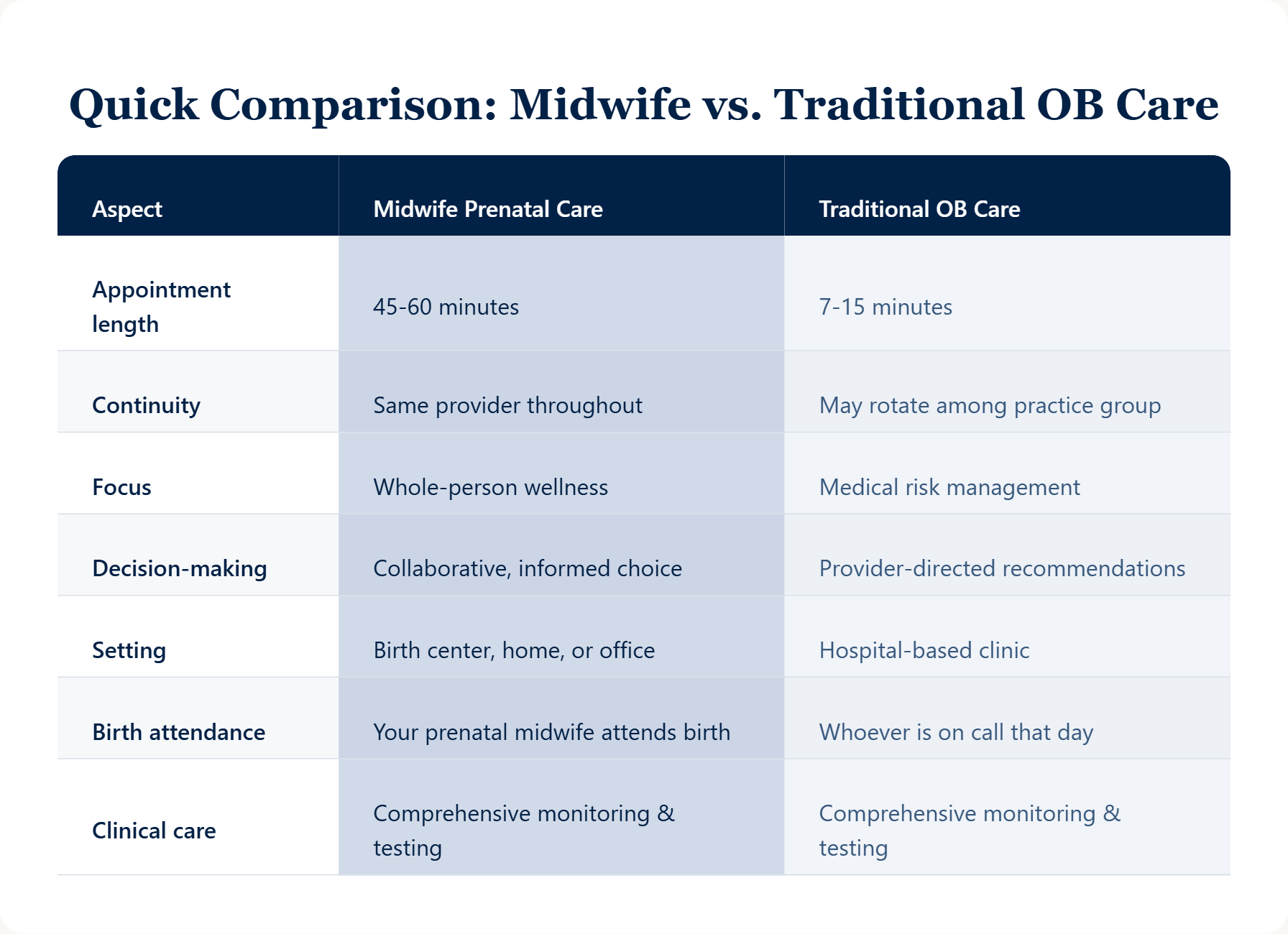
Most midwifery appointments last 45 to 60 minutes, sometimes longer for initial visits or when important decisions need to be made. Compare that to the typical 7-15 minute OB appointment, and you begin to understand why families describe midwifery care as transformative.
So what happens in all that time? Let's break it down:
What Happens at a Typical Midwife Prenatal Visit:
Personal check-in: "How are you feeling—really?" Your midwife asks about your energy, your emotions, your worries, and your excitement. This isn't small talk; it's assessment of your mental and emotional wellbeing.
Nutrition counseling: Detailed discussion about what you're eating, any cravings or aversions, and guidance tailored to your specific needs (managing nausea, preventing anemia, supporting optimal fetal growth).
Clinical assessments: Blood pressure check, urinalysis, weight tracking, fundal height measurement (that tape measure!), and listening to your baby's heartbeat—the same essentials you'd receive anywhere, but with explanation and context.
Physical comfort: Discussion of any aches, pains, round ligament discomfort, or other pregnancy symptoms, with suggestions for relief (positioning, exercises, when to seek additional help).
Education: Age-appropriate information about what's happening with your body and baby that week, what to expect next, and answering your questions without rushing.
Birth preparation: As you progress, conversations about your birth preferences, pain coping strategies, positioning, and what to expect during labor.
Partner involvement: Your partner or support person is welcomed and included, with attention given to preparing them for their role.
Postpartum planning: Discussion of newborn care, feeding plans, and setting up your support system for after birth.
Time isn't a luxury in midwifery care. It's a clinical tool. It allows your midwife to notice subtle changes, build trust, and truly know you as a whole person, not just a chart number.
The Clinical Essentials: Comprehensive and Evidence-Based
Let's be crystal clear: choosing a midwife doesn't mean choosing less thorough medical care. Texas Licensed Midwives are trained healthcare professionals who provide comprehensive prenatal monitoring that meets or exceeds standard guidelines.
Your midwife will conduct all the clinical essentials:
Initial health screening: Complete medical, surgical, and family history; physical exam; risk assessment
Routine monitoring: Blood pressure, weight, urine testing at every visit
Fetal assessment: Fundal height measurement, fetal heart tones, position checks
Laboratory testing: First trimester labs (blood type, Rh factor, anemia screening, STI testing, immunity checks), glucose screening, Group B Strep testing
Ultrasound coordination: Ordering dating scans and anatomy ultrasounds through partnering facilities
Additional testing: Offering genetic screening options, discussing amniocentesis or other diagnostic tests when indicated
Risk screening: Continuous evaluation for conditions requiring specialist consultation (gestational diabetes, preeclampsia, growth concerns)
The difference isn't what gets done—it's how. Your midwife explains each test, discusses what the results mean, and helps you understand why certain screenings matter. You're an active participant, not a passive recipient of care.
Holistic Support: Caring for the Whole You
Here's where midwifery care truly diverges from the conventional model. Your midwife understands that a healthy pregnancy isn't just about normal blood pressure and appropriate fetal growth. It's about your sleep quality, your stress levels, your relationship with your partner, your support system, and your emotional preparation for the massive transition ahead.
During your appointments, expect conversations about:
Sleep and rest: Practical strategies for managing pregnancy insomnia, finding comfortable positions, and prioritizing rest
Stress and mental health: Screening for anxiety and depression, discussing coping strategies, and connecting you with counseling resources if needed
Movement and exercise: Guidance on safe, beneficial physical activity tailored to your fitness level and pregnancy stage
Relationship dynamics: How pregnancy is affecting your partnership and preparing your family for a new baby
Work-life balance: Managing job demands while protecting your health
Postpartum planning: Building your support network, meal preparation, understanding the reality of the fourth trimester
This holistic lens recognizes that you're not just growing a baby—you're becoming a parent, transforming your identity, and preparing for one of life's biggest transitions. Your midwife sees all of it.
Informed Choice: Your Body, Your Baby, Your Decisions
In the midwifery model, "informed choice" isn't a buzzword—it's a foundational principle. Your midwife's role is to provide you with complete, evidence-based information and then support whatever decision you make, even if it differs from what she might choose herself.
For every test, screening, or intervention, expect your midwife to discuss:
What the test or procedure involves
Why it's being recommended
The potential benefits
The potential risks or limitations
Alternative options
What happens if you decline
This might sound time-consuming, but it's empowering. You're never pressured into decisions based on fear or convenience. You're equipped to make choices that align with your values, your comfort level, and your individual circumstances.
Don't want the glucose tolerance test? Your midwife will discuss alternative monitoring strategies. Unsure about genetic screening? She'll help you explore your feelings and values around testing. Concerned about a specific intervention during labor? She'll ensure you understand all your options before that moment arrives.
True informed consent means you're the expert on your own life, supported by your midwife's clinical expertise.
The Relationship: A Trusted Companion for Birth
Perhaps the most profound difference in midwifery care is this: by the time you go into labor, your midwife isn't a stranger. She's someone who knows your story, your fears, your strengths, and your hopes for birth. You've shared tears, laughter, and vulnerable conversations. You trust each other.
This continuity of care has measurable benefits. Studies show that when women have a known, trusted provider at their birth, they experience:
Lower rates of medical interventions
Shorter labors
Reduced need for pain medication
Higher satisfaction with their birth experience
Better postpartum mental health outcomes
When labor begins and your midwife walks through the door—whether that's your bedroom, a birth center suite, or a hospital room if transfer becomes necessary—you feel relief. The person guiding you through the intensity of birth is someone you know, someone you've built a relationship with over months of care.
In many birth center and home birth settings across Texas, your midwife stays with you throughout your entire labor. There's no shift change, no rotation of unfamiliar faces. Just consistent, compassionate presence from someone who believes in your ability to birth your baby.
The Texas Touch: Where Care Happens
Texas midwives offer prenatal care in various settings, each designed to feel comfortable and personal:
Freestanding birth centers: Cozy, home-like spaces with comfortable furniture, often including bedrooms, living areas, and full kitchens
Home visits: Some midwives come directly to you, providing care in the comfort of your own space
Private practice offices: Welcoming clinical spaces that balance professionalism with warmth
Many Texas birth centers are tucked into converted homes, nestled in quiet neighborhoods, or located in peaceful rural settings. The environment itself communicates a different message: you're not sick, you're not a patient in the traditional sense—you're a healthy person experiencing a normal life event, and you deserve care that honors that.
Is This What You're Looking For?
Midwifery prenatal care offers something increasingly rare in modern healthcare: time, attention, and genuine relationship. It combines thorough clinical monitoring with holistic support, evidence-based practice with respect for your autonomy, and professional expertise with personal connection.
If this resonates with you—if you're looking for more than measurements and brief check-ups—midwifery care might be exactly what you need for this journey into parenthood.
Ready to experience prenatal care that goes beyond the tape measure? Find a Texas Licensed Midwife through the Association of Texas Midwives directory at www.texasmidwives.com and schedule that first appointment. You deserve care that sees all of you.